
Branford City Directory Holdings
Branford directories begin with 1895 and continue in a nonannual sequence. The Blackstone directory guide identifies Price & Lee Co. of New Haven as the publisher through 1978, followed by other publishers. The Branford year list is useful because it shows where a search can begin, but it also warns against treating an unlisted year as a gap in a household's history.
| Collection | Years | Where Held | Access |
|---|---|---|---|
| Price & Lee early volumes | 1895, 1897; 1900, 1904, 1909; 1913, 1916 | Blackstone Branford Room and selected scans | Nonannual; inspect the volume and page |
| Price & Lee selected runs | 1920, 1925, 1926, 1928; 1930, 1932, 1936, 1939; 1942, 1946; 1950, 1953, 1958 | Blackstone Branford Room | Street index begins in 1928 |
| Later Price & Lee years | 1960, 1962, 1964-1969; 1970, 1971, 1973, 1974, 1976-1978 | Blackstone Branford Room | North Branford included from 1960 |
| Later-publisher volumes | 1981-1983, 1985-1989; 1990-1999; 2000-present, selected | Blackstone Branford Room and the digitized item set | Later companies; not an annual run |
| Street index and reverse use | Begins in 1928 | Blackstone directory volumes | Search a number, then verify the resident entry |
Note: The guide lists 1916 while an archive description says 1917, so verify the volume; no official final printed year was located.
Blackstone's Branford Directory Shelf
Blackstone Memorial Library is the main local history access point for Branford. Its Branford Room and reference desk are at 758 Main Street, with the Branford library phone at 203-488-1441 and reference extension 318. Listed hours are Monday through Thursday, 9 to 8, Friday and Saturday, 9 to 5, and Sunday, 1 to 4 from September through May. Staff ask researchers to contact them ahead of time or make an appointment when a request needs a particular volume, finding aid, or scan.
Branford materials generally remain in the building. Staff can provide copies or scans when condition and permission allow. A useful request names the person or place, approximate years, street or family spelling, record type, and whether a scan or citation is needed. Some Branford library databases require in-building use.
The Blackstone Branford local-history resources page places directories beside census material, newspapers, maps, yearbooks, vital indexes, house surveys, and family collections.
The Blackstone Branford directory collection view shows the archive route used for digitized items and item-level browsing.
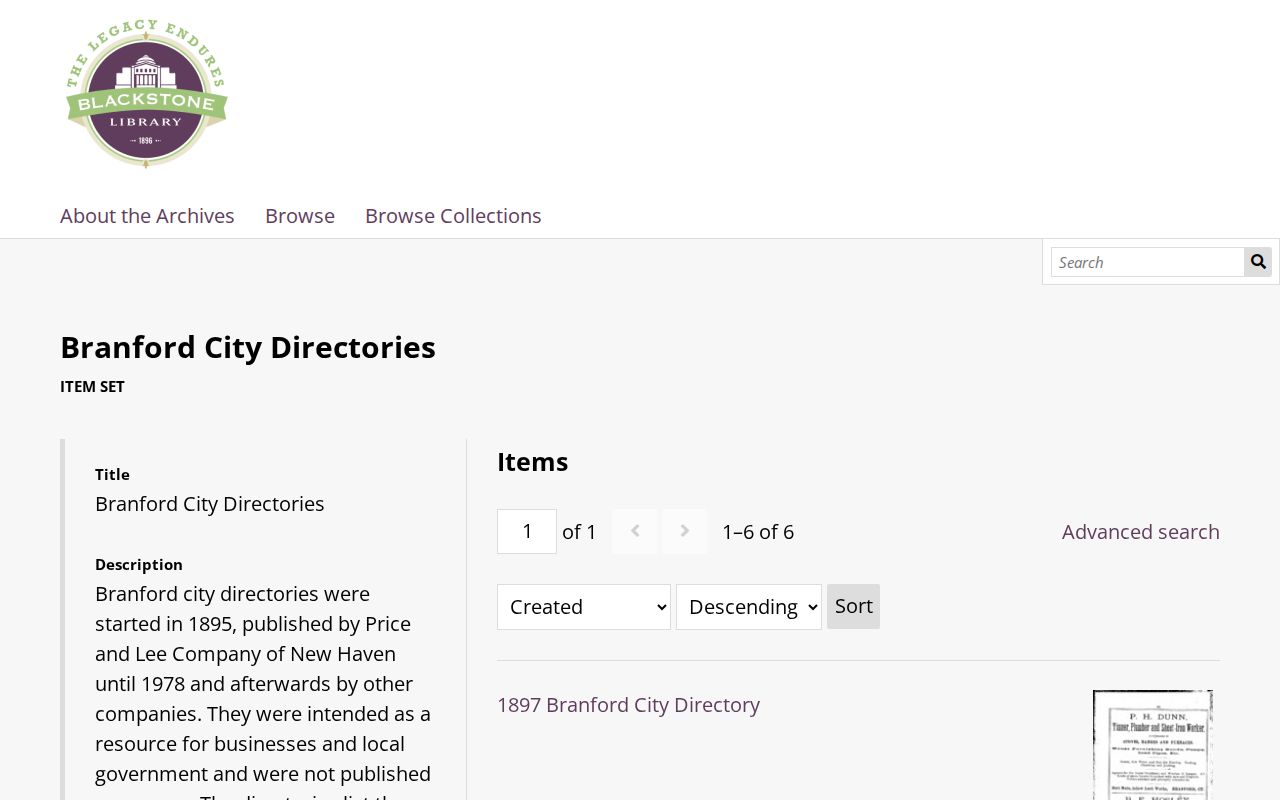
Note: Blackstone staff confirm access, copies, and year-specific limits when the shelf or scan does not answer the request.
Branford City Directories Online
Digital access is split across several places. The Blackstone archive browse offers a route to Branford material, including a digitized 1909 volume. The Branford scan can show the title, page, resident section, civic material, and abbreviations, but a search result or thumbnail should not be treated as the complete entry until the page image is inspected.
The digitized Branford history archive supplies the manifest route for searchable local-history pages.
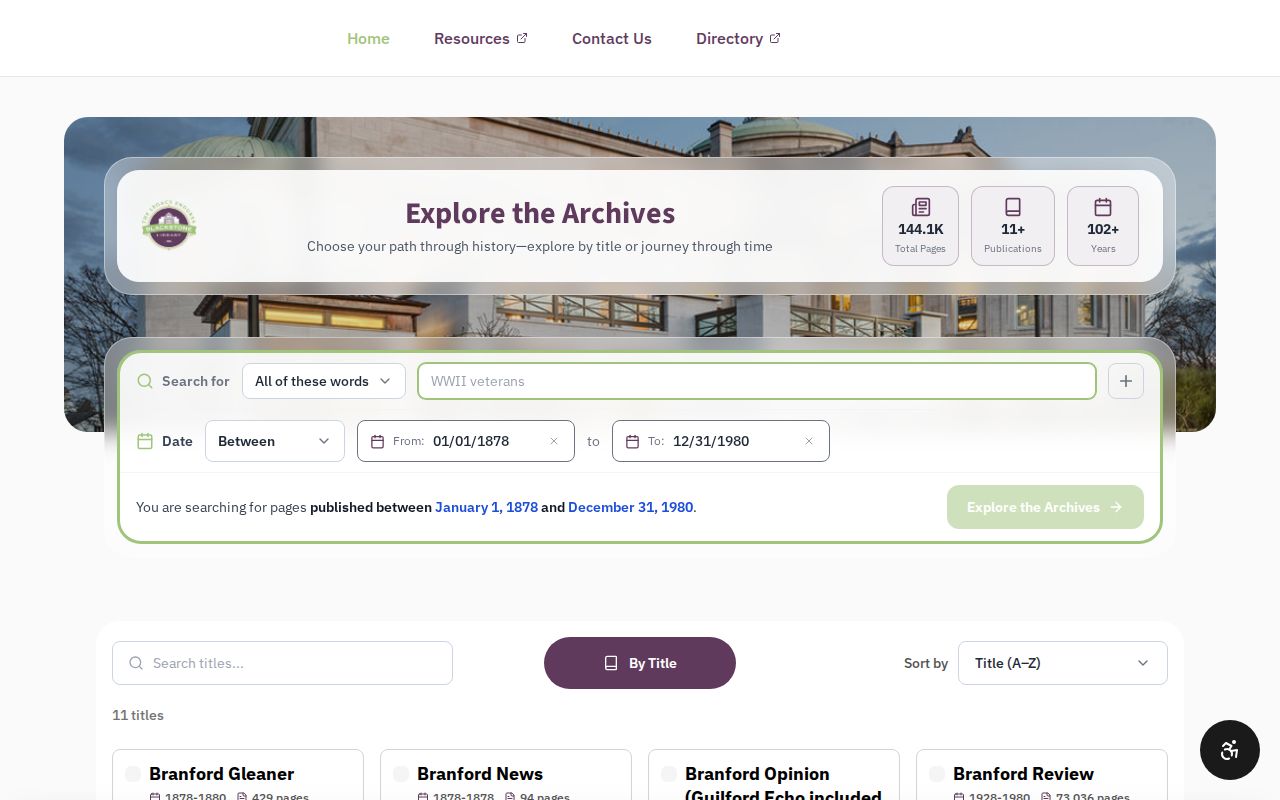
The Branford digitized view can preserve a dated page when a shelf visit is not practical, but the citation should retain the volume year, page or image, and access date.
Branford newspaper access adds another digital route. Blackstone identifies a searchable Branford archive through 1980 and an Advantage Preservation route. Search names, places, organizations, and issue dates, then inspect the image.
Note: A newspaper mention is dated evidence, not automatic proof of residence; library microfilm is the fallback when search text misses a name.
Reading a Branford City Directory
A Branford entry is a dated address record, not a present-day identity statement. The Branford 1909 synopsis describes a surname and given name, status or occupation, home or boarding line, street or locality, and sometimes a number. Business listings may point to a home entry. Later volumes add street indexes, advertisements, civic material, and notes about a move, marriage, or death.
Copy the Branford printed wording first. A Branford landmark may outlast a number, and a boarding notation does not establish a household. Wives' names appear more often after 1928, but a spouse note must be reported only when printed.
| Name | Copy the surname and given name as printed, including a variant spelling. |
|---|---|
| Occupation or status | Transcribe the status or occupation and any place-of-business cross-reference. |
| Spouse or household note | Capture a spouse, widow, move, marriage, or death note only when the volume prints one. |
| Address | Keep the home or boarding line, street or locality, number, and landmark separate. |
| Owner or renter mark | If a volume shows a mark, copy its symbol and read the key before assigning a meaning. |
- Criss-cross directory
- The street-order or address side of a volume. In Branford, the library guide identifies this use from the 1928 street index onward.
- Householder index
- An address-to-name aid that points from a street and number to a listed household or occupant. Verify the name in the resident section.
- Abbreviation key
- The volume's guide to status, address, or other short marks. Read it before expanding a symbol or treating a blank as a fact.
The 1909 Branford Directory Snapshot
The Branford 1909 scan is more than a list of residents. It includes abbreviations, advertisements, the library, borough officers, businesses, cemeteries, census material, churches, fire information, post offices, schools, societies, town officers, and resident names. A family-history researcher can pivot from a name to the civic setting recorded in the same volume.
The Branford production summary shows why a directory is a dated snapshot. The 1904 edition reports 2,089 names, 271 removals, 620 additions, and 635 erasures. The 1909 summary reports 2,074 names, 262 removals, 305 address changes, and 1,822 total changes. These are production figures, not Branford population counts or Branford household counts. “Removed” means removed from that edition, not necessarily deceased or permanently gone.
The Branford 1909 digitized volume should be cited by title, year, page or image, URL, and access date. Compare its nearest available earlier and later editions, then use a newspaper, census page, land record, or vital index to test a change.
Branford Directories by Street
The Branford street index begins in 1928 with street numbers and occupants. Start with the number and street, then turn to the resident section to confirm the entry. Maps often begin in 1928 but may be missing, so a later map or parcel layer can orient the search without replacing the historical page.
North Branford was not separately covered until 1960 and is included in later Branford material. Keep the Branford directory's place label, year, and page, then compare the street index with a newspaper, census, or land record. A missing number calls for a landmark, business name, nearby street, or older spelling.
For a current Branford address-keyed chain, the Branford street directory handles modern parcel and street sources, while these Branford volumes remain historical evidence. A directory entry can show that a name was listed at a place on a date, but it cannot alone prove continuous occupancy.
Note: A missing map, year, or street number records a source gap, not proof that the place or household was absent.
Branford Directory Companion Sources
Blackstone's Branford microfilm holds Branford News, February 28-August 9, 1878; Branford Gleaner, February 28, 1878-March 3, 1880; Branford Opinion, January 4, 1896-March 13, 1913; and Branford Review, April 13, 1928-December 11, 2008. Another description starts the Gleaner in September or October 1879, so verify the reel.
The Branford library also identifies census material from 1790-1940 with 1890 missing, a copy of the 1670 Branford census, vital and church indexes, cemetery material, and yearbooks from 1925-present with 1933/34 missing. Use the library, Town Clerk, FamilySearch, or the Connecticut State Library guide when an index ends, and cite each source separately.
Branford Directory Archives at Society
The Branford Historical Society adds manuscripts, photographs, surveys, and finding aids around the printed directory shelf. After a 1994 agreement, most material moved from Harrison House to the Blackstone Branford Room. The Society describes roughly 40 photo boxes, 15 negative boxes, and about 30 manuscript boxes. Digitization began in the mid-2010s, followed by a Society and town partnership on James Wesson Phelps survey maps.
The Branford inventory names land records from 1743-1847, Towner deeds and surveys around Short Rocks and Mill Plain, probate and estate material from 1739-1884, correspondence from 1789-1945, and births, marriages, and deaths from 1795-1902. Most manuscripts are not digitized. Access runs through the library reference desk and Society finding aids. Contact archives@branfordhistoricalsociety.org or 203-488-4828; Harrison House is at 124 Main Street, Saturday 1 to 4 June through September or by appointment. Photograph copies require permission.
The Branford Historical Society archive page is the manifest source for the archive-access image.
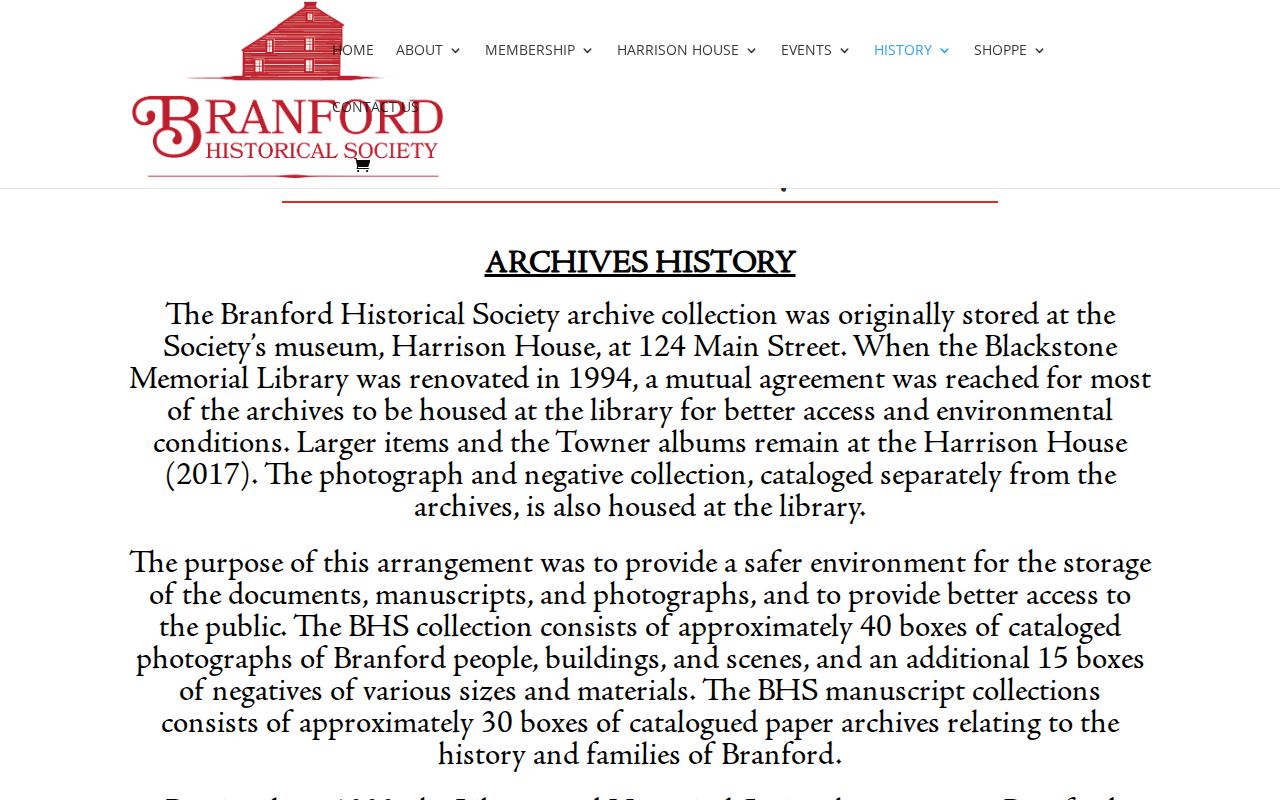
The Branford archive image represents a finding-aid and access route, not a promise that every manuscript or photograph has a searchable digital copy.
Branford Directory Timeline
Branford's record trail runs from settlement records through print, indexes, archive transfers, and digital access.
| 1644 | The town history dates first settlement to 1644 and identifies Totokett as the earlier place name. |
|---|---|
| 1895 | The first listed Branford directory year begins the local printed run. |
| 1909 | A digitized volume records resident names alongside civic, business, school, church, and town material. |
| 1928 | The library guide places the street index, with numbers and occupants, in the later sequence. |
| 1960 | Later Branford material includes North Branford, which was not separately covered before this point. |
| 1978 | Price & Lee publication reaches its documented endpoint; later publishers continue selected years. |
| 1994 | Most Historical Society material moves to the Blackstone Branford Room under the archive agreement. |
| 2000-present | The guide lists selected current material, but no official final printed year was located. |
The Branford 1916 and 1917 descriptions should remain visible as a catalog discrepancy. Checking the Branford source volume is part of the research, not a reason to choose one year silently.
Tracing Branford Families Through Directories
Branford family-history work is strongest when each directory year is paired with another dated source. Preserve spelling variants and the place label, then use the nearest available volume instead of waiting for an annual sequence.
The Blackstone house-history and local-history collection guide is the manifest source for the fourth image below.
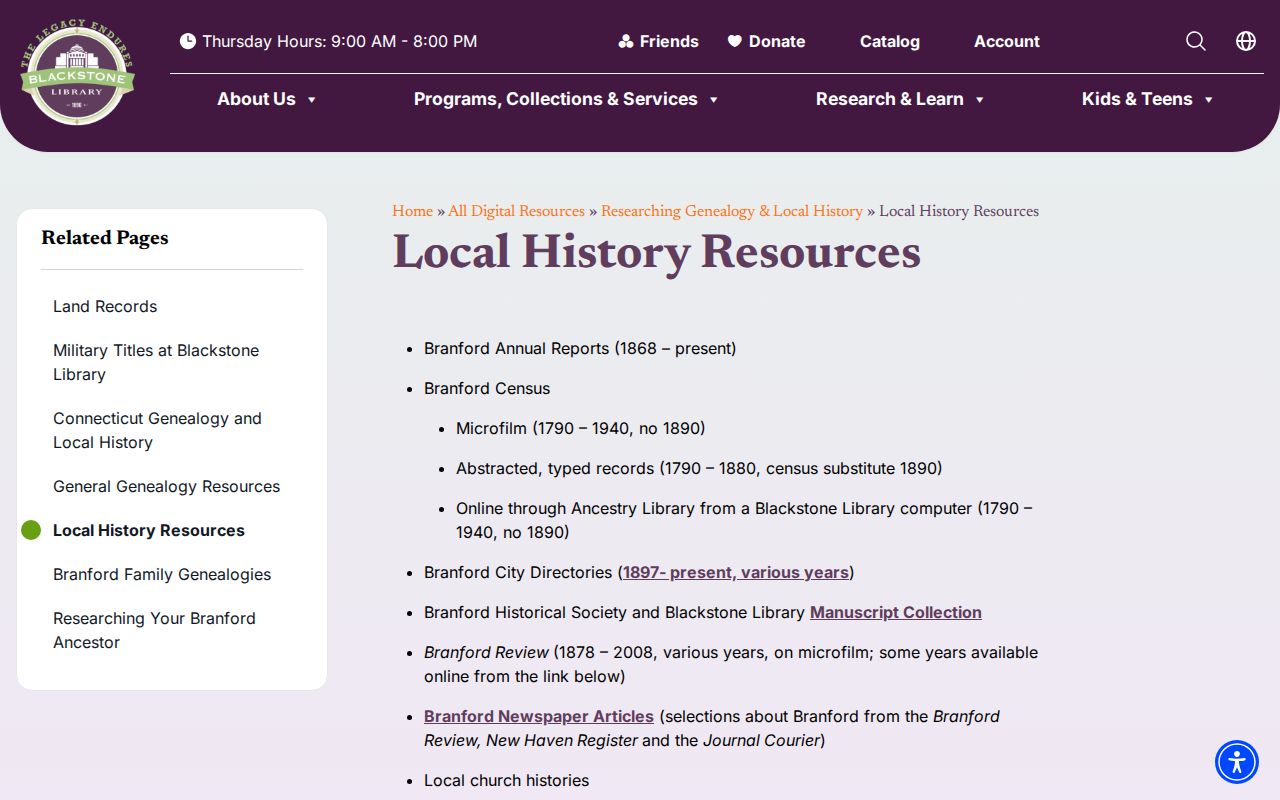
Branford house-history material can connect a directory line to maps, yearbooks, newspapers, and finding aids without making one item a complete household record.
- Choose a Branford person, family, street, or place, then note spelling and landmark variants before opening a volume.
- Find the nearest Branford directory year and capture the name, address, page or image, and household note.
- Compare Branford editions, follow address changes, and use the street index when a number is available.
- Pair directory years with the 1790-1940 census sequence, remembering that 1890 is missing, and use the 1670 Branford copy for earlier context.
- Close a gap with a newspaper, vital, church, cemetery, land, obituary, or Historical Society source, citing each point.
A Branford disappearance can mean a move, death, an unlisted household, a missed edition, or a change in compilation. A Branford newspaper, census, cemetery, church, vital, or land record can narrow the explanation, but an old listing is not present-residence proof. Send certification or correction questions to the named Branford custodian.